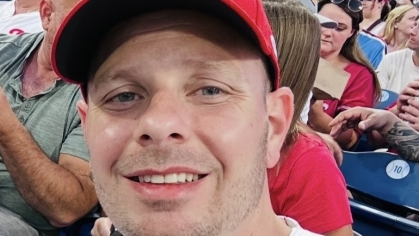
Samuel McIntyre, an undergraduate student studying at Rutgers School of Social Work, is one of the record 20 students across Rutgers University who was awarded the prestigious Benjamin A. Gilman International Scholarship earlier this year. The award empowers students of limited financial means to study or intern abroad, fostering mutual understanding between the United States and other countries.
Below, he shares a glimpse into his experience studying abroad in Romania last summer.
I had always been interested in studying abroad, but the financial reality of being a student made the experience feel out of reach. Between tuition, living costs, and the need to work while in school, I could never picture myself traveling internationally, let alone completing an internship overseas. This past summer, the Benjamin A. Gilman International Scholarship changed that reality. The Gilman Program removed the financial barriers that once made studying abroad unattainable and allowed me to gain hands-on experience in cross-cultural social work while broadening my perspective on the world and on the field I hope to enter.
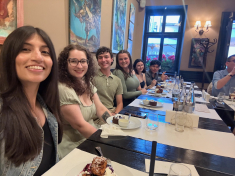
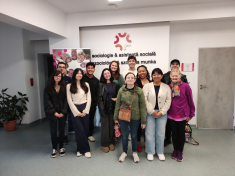
The Rutgers-Romania’s Revolution global internship provided me with an opportunity to connect with international social service organizations and collaborate with professionals supporting vulnerable communities within a Romanian cultural context. I first learned about the program from a classmate who had participated the previous summer. He described working at a community day center with adults with disabilities during the week and exploring Romanian culture in his free time. The way he talked about the program as transformative, challenging, and deeply meaningful sparked something in me. Even then, though, I assumed finances would make it impossible for me to experience the program. The Gilman Scholarship not only made it possible but also encouraged me to reflect on why I wanted to participate, how the experience connected to my identity as a social work student, and how I could continue the impact once I returned home.
During the month I spent in Cluj-Napoca, my internship involved working at two sites. I began each morning at Asociatia Misionarii lui Padre Pio, an afterschool and community program for children from disadvantaged families. My days often started in the backyard, where the kids and I played soccer, swung from monkey bars, and made up our own games with balls, tires, and whatever we could find. Because most of the children spoke only Romanian, we relied on nonverbal communication like gestures, laughter, and Google Translate to communicate. These nonverbal interactions quickly became one of my favorite parts of each day.
I ate lunch with the children and staff, giving me time to learn about Romanian culture, school expectations, and the social and political issues affecting families in the region. Talking with staff members helped me understand the broader systemic challenges Romanian families face through the perspective of Romanians, deepening my awareness of how culture and policy shape everyday life for children. Although Padre Pio was not my main placement, it played a significant role in grounding me in the community and broadening my understanding of cross-cultural social work.
After leaving Padre Pio each day, I took the bus to my primary placement at Fébé-Fogyatékkal Élő Felnőttek Otthona (Fébé)’s Empowerment Center for Adults with Disabilities, a nonprofit dedicated to promoting independence, dignity, and social connection among adults with disabilities. I worked alongside Romanian social service workers to create and facilitate group activities such as crafts, community events, and games to support psychosocial development and self-esteem while promoting joy among residents. My daily tasks required creativity, adaptability, and cultural humility as I learned how to effectively communicate and support clients despite language and cultural differences.
One of the most meaningful parts of my experience at Fébé involved supporting a resident who could not leave her room due to health complications. While most group activities took place in common spaces, she was often isolated. After recognizing the barriers she faced, I collaborated with other interns to create a daily routine where at least two of us spent time with her. We brought music, small crafts, and conversation to promote the social work values of human dignity, the importance of human relationships, and equity. These visits reminded me of the importance of meeting clients where they are physically, emotionally, and developmentally, and it reinforced the value of individualized care in social work practice.
Throughout the month, the language barrier sparked the most valuable lessons I learned. Because only one resident at FEBE spoke limited English, I relied heavily on non-verbal communication like eye contact, gestures, tone, and body language. This pushed me to be more intentional, patient, and observant than ever before. I learned how rapport can be built without words and how shared human connection transcends language. These skills will continue to shape how I engage with clients across diverse backgrounds throughout my future practice.
My internship also encouraged me to learn about Romania’s political history, the aftermath of the revolution, and the country’s evolving landscape of disability rights. Compared to the United States, Romania’s social work profession is still relatively young, leading to underfunded programs and wide systemic gaps. Speaking with staff at both Padre Pio and FEBE helped me understand how history, policy, and culture interact within Romanian social welfare systems. Professionals emphasized how these factors have intersected to create the under-resourced, stigmatized social and institutional systems that serve Romanians with disabilities. These conversations broadened my perspective on global social work and reinforced my commitment to advocating for marginalized populations.
Professionally, this experience changed me. I returned from Romania more confident in my ability to integrate theory with practice, more aware of my own biases, and more grounded in an empowerment-based, person-centered approach to social work that aligns with my personality and values. Working across cultures and systems expanded my understanding of what dignity, inclusion, and community support look like in different contexts. It also strengthened my commitment to pursuing an MSW degree and continuing work with marginalized communities both locally and globally.
The Gilman Scholarship made an experience possible that profoundly shaped the way I see the world and my place within the social work profession. I hope this reflection helps demystify the process and highlights how global learning can deepen one’s academic, professional, and personal growth. I also hope my experience encourages other Rutgers students—especially those who may assume, as I once did, that studying abroad is not financially possible for them—to explore international social work opportunities and to recognize the value that global engagement can bring to their education and practice.